Note: The translation for this entry is currently under quality review. Some content is temporarily displayed in English only.
wild
/waɪld/
The central image is one of absence: the absence of human control, boundaries, or domestication. It evokes a sense of raw, untapped energy and unpredictability. When applied to nature, it carries a neutral or positive connotation of purity and freedom, though in some contexts, it suggests danger or hostility (the "wilds"). When describing human behavior, it shifts toward an emotional peak. It describes a state where social filters and inhibitions are dropped, often associated with excitement, chaos, or passion. In the context of ideas or guesses, it implies a leap of faith. It suggests a lack of evidence, leaning into the improbable or the imaginative rather than the logical.
💬Trò chuyện
Bro that last clutch was wild. How'd you even pull that off?

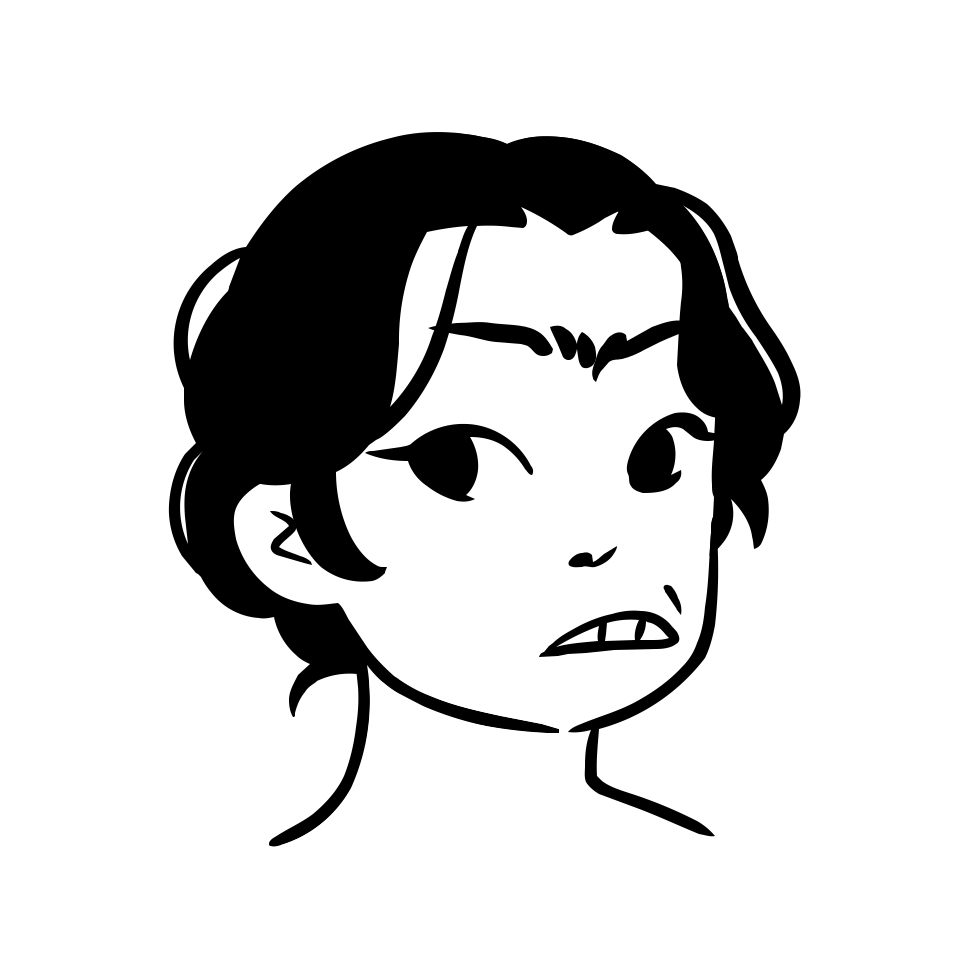
Idk man, just pure luck I guess. My heart was pounding.
Ý nghĩa
Living or growing in a natural state; not domesticated or cultivated.
"We saw several wild horses running across the plains."
Lacking discipline or restraint; uncontrolled and exuberant.
"The crowd went wild when the band finally took the stage."
Produced by an unrestrained imagination; fantastic or improbable.
"That is a wild guess, but it might actually be correct."
Ví dụ
I just love seeing wild flowers in the spring!
Stop it! You're acting absolutely wild right now!
That is a completely wild theory, don't you think?
I can't believe we're actually heading into the wild!
The kids went wild when they saw the cake.
Look, it's just a wild guess, okay? Calm down!
We need to protect these wild habitats immediately.
Seriously? You want to spend a month in the wild?
My hair looks so wild in this humidity!
It was a wild party, but I'm exhausted now.
Cụm từ kết hợp
wild animals
Animals that live in a natural state and are not domesticated.
go wild
To become uncontrolled, exuberant, or lose one's restraint.
wild guess
A conjecture based on little or no evidence; a fantastic or improbable guess.
into the wild
Entering an uncultivated, uninhabited region or wilderness.
wild imagination
An unrestrained capacity for creating fantastic or improbable mental images.
Thành ngữ & Tục ngữ
run wild
To behave in an unrestrained or uncontrolled manner.
go wild
To become very excited, enthusiastic, or out of control.
a wild goose chase
A foolish or hopeless search for something unattainable.
wild guess
An estimate or conjecture made without any supporting evidence.
in the wild
In a natural state; not in captivity or a controlled environment.
Bối cảnh văn hóa
The Wild Heart of Storytelling: Unraveling Our Primal Connection to the Untamed
From the earliest cave paintings to the most modern blockbuster films, the concept of 'wild' has always held a potent allure for humanity. It speaks to a primal part of ourselves, a connection to the untamed forces of nature and the untamed aspects of our own psyche.
Think about the archetypal journey: a hero often leaves the safety of civilization to venture into the wild. This wild can be a literal forest, a vast ocean, or a metaphorical inner landscape of chaos and self-discovery. It is in these wild spaces that true tests occur, where characters confront their deepest fears and discover their true strength. The wild represents the unknown, the unpredictable, and the dangerous, but also the place of profound transformation and authentic experience.
In mythology, the wild is often personified by powerful, untamed deities or creatures. The wolf, a symbol of both ferocity and community, roams the wild spaces of folklore. The untamed horse, a creature of pure spirit, represents freedom and power. These symbols tap into our collective unconscious, reminding us of the raw, instinctual energy that exists beyond the confines of societal norms.
Even in our modern, sanitized world, we seek out the wild. We go on camping trips, hike remote trails, and watch nature documentaries, attempting to reconnect with this essential part of ourselves. The wild is not just an external environment; it's an internal state. It’s the realm of intuition, creativity, and passion – the parts of us that resist being fully domesticated. Our fascination with the wild is, in essence, a fascination with our own deepest, most authentic selves, a reminder that even in our most civilized lives, a wild heart still beats within.
Từ nguyên
Derived from Old English 'wild', from Proto-Germanic 'wilþaz', originating from the Proto-Indo-European root 'wel-', meaning 'to will' or 'to wish'. In its earliest Germanic contexts, it referred to that which is "willful" or uncontrolled, evolving into the sense of being untamed, natural, or unrestrained.