Note: The translation for this entry is currently under quality review. Some content is temporarily displayed in English only.
very
/ˈvɛɹi/
When used as an adverb, "very" makes an adjective or another adverb stronger. For example, "very happy" is more intense than just "happy." Be careful not to use "very" with "strong" adjectives. For instance, instead of saying "very exhausted," it is more natural to say "completely exhausted" because "exhausted" already means "very tired." When used as an adjective, "very" helps you point out a specific thing or person to show that it is exactly the one you mean.
💬Casual Conversation
David's on a warpath. He looks very tweaked right now.
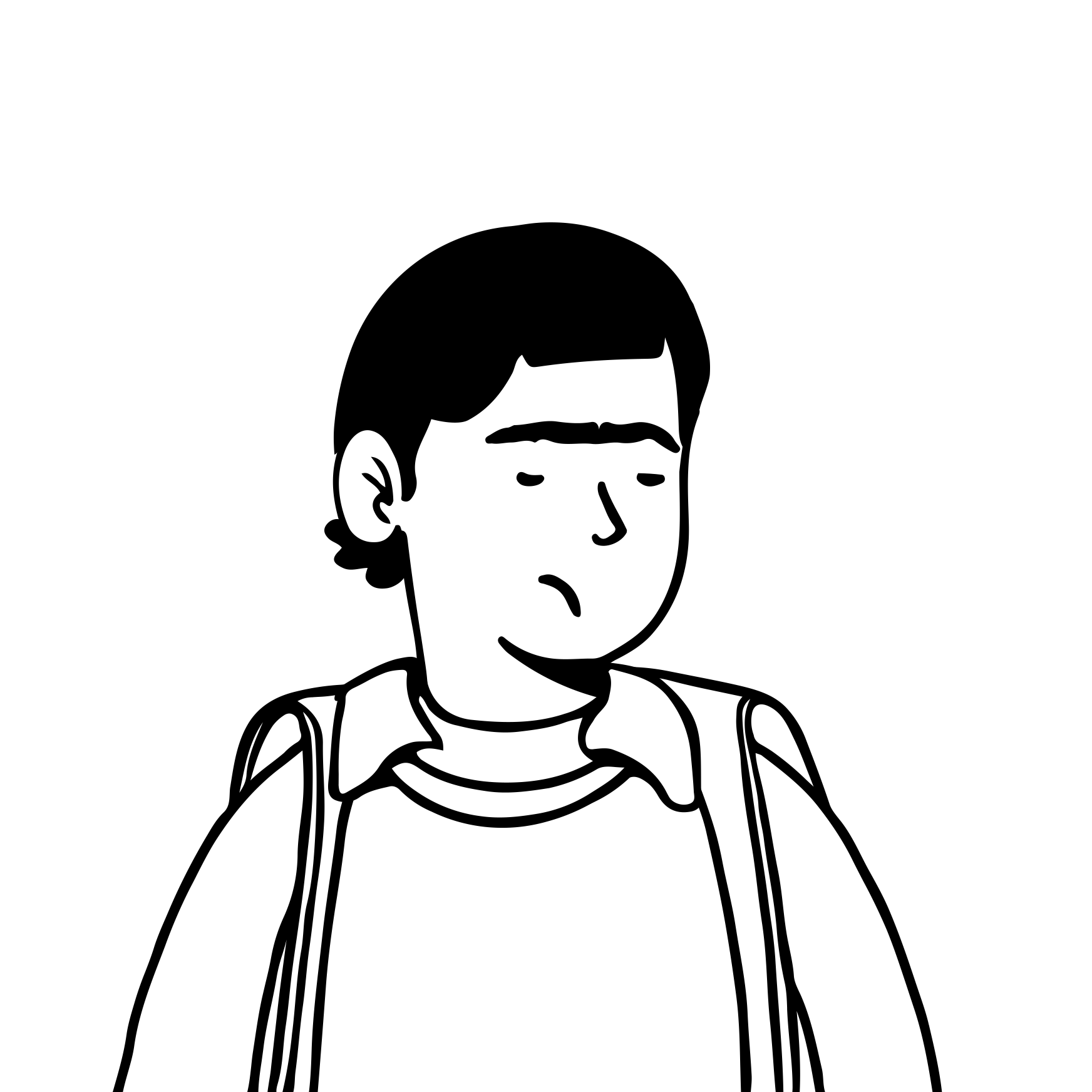

I'm ghosting him until 5. Don't sell me out.
Meanings
Examples
This soup is very salty, I can't even eat it!
You are the very person I've been searching for all night.
I am very tired after that long flight.
Wait, this is the very spot where it happened!
The movie was very exciting from start to finish.
I'm very disappointed that you lied to me again!
It is a very beautiful day outside.
That is the very dress I wanted to buy!
Collocations & Compounds
very few
A small number of; not many.
the very best
Of the highest possible quality or standard.
very well
In a satisfactory manner, or used as a polite agreement.
at the very moment
Exactly at that particular time.
the very end
The absolute final part of something.
Idioms & Sayings
the very least
The smallest amount or degree possible.
the very best
Of the highest quality or excellence.
at the very moment
Exactly at that specific time.
Cultural Context
In the hallowed halls of creative writing workshops and prestigious editing suites, there is a recurring villain that every aspiring author is taught to slay: the word "very". From early grade school through university, students are told that "very" is a lazy modifier—a linguistic crutch used by writers who lack a precise vocabulary. The logic is simple: why say "very tired" when you could say "exhausted"? Why settle for "very angry" when "furious" captures the raw intensity of the emotion far more effectively?
However, this stylistic crusade ignores a fascinating psychological truth about how humans actually communicate. In natural spoken language, "very" acts as a vital emotional intensifier. It is not merely about the degree of an adjective; it is about the speaker's subjective experience of that degree. When we say something is "very cold," we aren't just describing a temperature; we are communicating our personal reaction to that chill. The word serves as a bridge between objective description and human feeling.
Furthermore, there is a subversive power in the simplicity of "very". Consider the legendary minimalist style of Ernest Hemingway. While he avoided flowery adjectives, his prose often relied on simple, direct intensifiers to create a sense of stark reality. By stripping away the complex Latinate synonyms (like replacing "exquisite" with "very beautiful"), a writer can actually achieve a more honest, raw, and visceral tone that resonates with the reader's own internal monologue.
Ultimately, the tension surrounding this word is a battle between formal precision and emotional authenticity. While a dictionary may define it as simply "in a high degree," in the hands of a master communicator, "very" becomes a tool for pacing and emphasis. It proves that sometimes, the most common words are the most powerful because they occupy the center of our shared consciousness, allowing us to convey urgency and intensity without distracting the listener with an overly academic vocabulary.
Etymology
Derived from the Old French word 'verai' (meaning 'true'), which stems from the Latin 'verus'. It originally functioned as an adjective meaning 'true' or 'genuine'; its use as an intensifier (adverb) developed through the process of semantic bleaching, where 'true' evolved into 'truly' and eventually became a general marker of high degree.