own
/ˈəʊn/
The word carries a strong sense of boundary and identity. When used to describe possession, it goes beyond simple ownership to signal autonomy, independence, and a personal claim. It distinguishes the individual's territory from that of others, often evoking a feeling of pride or self-reliance. As a verb of admission, it shifts from legal possession to moral accountability. To "own" a mistake is to stop distancing oneself from an action and instead integrate it into one's history. This usage is heavily tied to integrity and the act of taking full responsibility without evasion. Compared to "possess," which can feel clinical or formal, "own" is more direct and visceral. It describes not just a legal state, but a relationship of control and authority over an object or a truth.
💬Casual Conversation
i'm legit about to crash. i wish i had my own place so i could just nap.
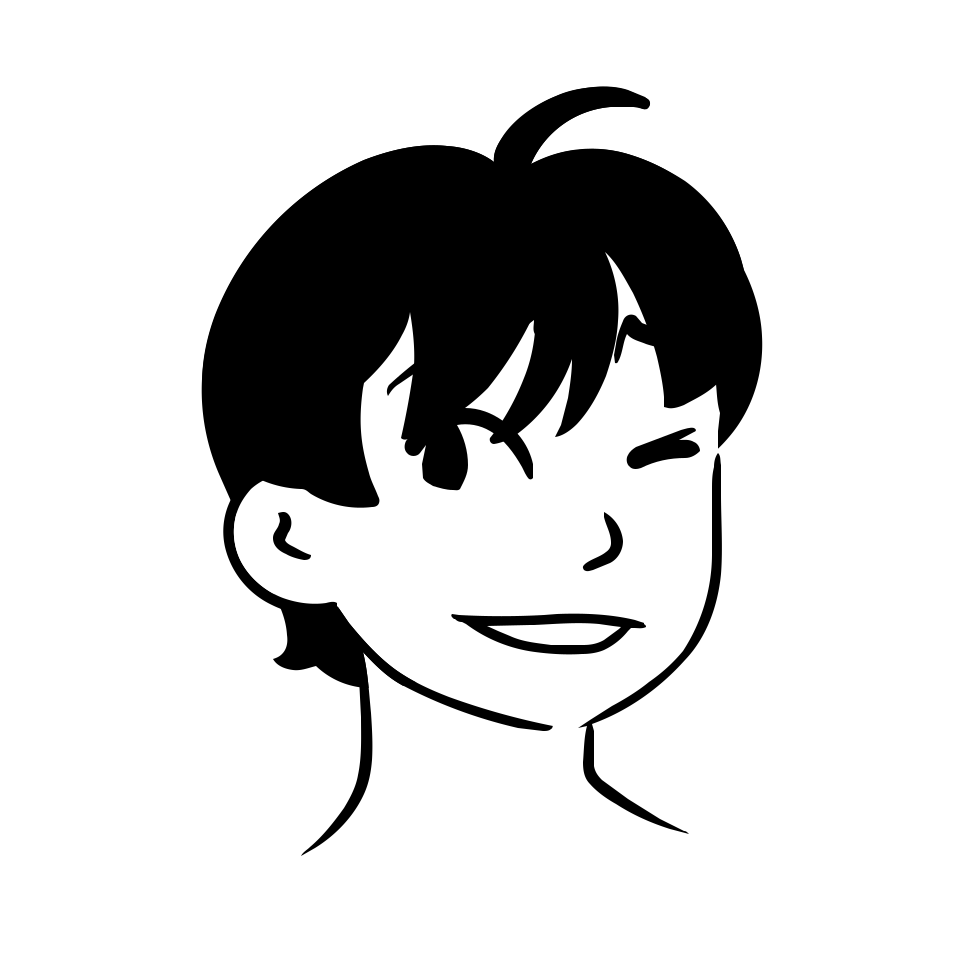
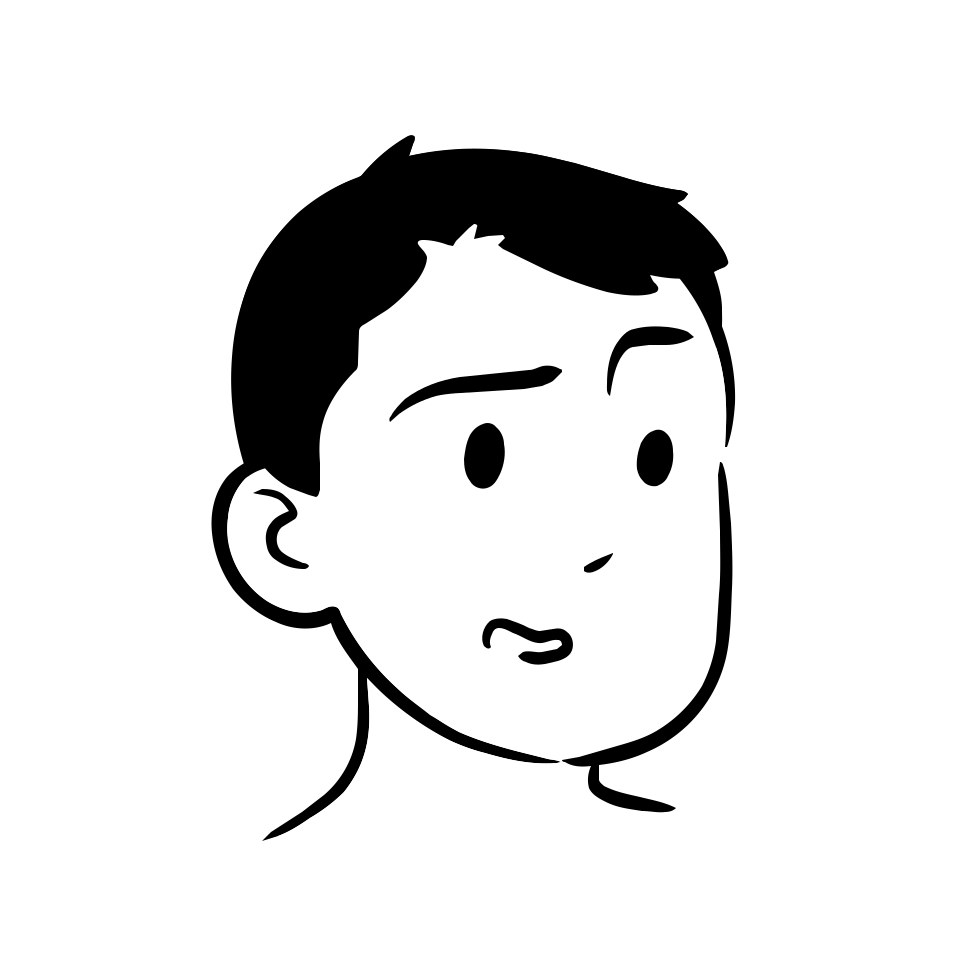
stop dreaming and get your act together. you're failing art history.
Meanings
To possess something; to have legal title to.
"She owns a small cottage by the sea."
To admit or acknowledge that one has done something, especially something wrong.
"He finally owned his mistake after the evidence was presented."
Used to emphasize that something belongs to a particular person.
"I want to start my own business one day."
Examples
She owns a small cottage by the sea.
I want to start my own business one day.
Each student must bring their own notebook.
He finally owned his mistake after the evidence was presented.
Look, just own it! You lied to me!
Wait... you actually own this entire block of flats?
I can't believe you used my own toothbrush!
Do you own the car, or is it a lease?
I'm tired of living in my parents' own house.
Why can't you just own up to the mess?
Collocations & Compounds
own up to
To admit that one has done something wrong.
on one's own
Alone or without help from others.
my own two eyes
Used to emphasize that someone saw something personally.
own a home
To possess legal title to a residential property.
of one's own
Belonging specifically to the person mentioned.
Phrasal Verbs
own up
To admit to something, especially a mistake or a crime; to acknowledge responsibility.
own up to
To confess to a specific action or fault.
Idioms & Sayings
on one's own
Alone, or without help from others.
of one's own accord
Voluntarily; without being asked or forced.
own up to something
To admit that one is responsible for something, especially a mistake or crime.
make it one's own
To adapt something so that it reflects one's own personality or style.
for one's own sake
For the benefit or advantage of the person mentioned.
Cultural Context
The Endowment Effect: Why We Overvalue What We Own<br><br>In the realm of behavioral economics, the concept of ownership triggers a fascinating psychological phenomenon known as the endowment effect. This occurs when individuals place a significantly higher value on an object simply because they own it, compared to how they would value the exact same object if they did not possess it. This cognitive bias suggests that the act of owning creates an emotional bond that transcends the actual market utility of the item.<br><br>This instinctual attachment is deeply rooted in human evolutionary psychology. In ancestral environments, securing and owning resources was a primary driver of survival. Today, this manifests in everything from the sentimental value we attach to a childhood toy to the reluctance of homeowners to sell their houses for a fair market price. The transition from wanting something to owning it fundamentally alters our perception of value, turning a mere commodity into a part of our personal identity.
Etymology
Derived from Old English 'āgen', the neuter form of 'āgen', meaning 'one's own'. This originates from the Proto-Germanic root 'aigan' (to possess), which is related to the Gothic 'aigan' and Old High German 'eigen'. The verbal sense 'to admit' developed later through a metaphorical extension of possessing or claiming responsibility for an action.