change
/tʃeɪndʒ/
The word represents the fluid transition from one state, object, or value to another. It is a neutral term that can swing toward positive ('a welcome change') or negative ('climate change') depending on the context. When used as a verb for alteration, it implies a modification of essence or appearance. When used for exchange (like clothes or money), it emphasizes substitution—removing one thing to make room for another. In its noun form regarding currency, it refers specifically to the fragmented nature of money (coins) rather than the whole (bills). This creates a distinct conceptual leap from 'transformation' to 'physical remnants'.
Countable when referring to a specific event or modification ('a change in the law'). Uncountable when referring to coins in your pocket or the general concept of evolution ('Climate change is accelerating').
💬Casual Conversation
I'm absolutely gutted. The weather on Earth must be such a welcome change right now.
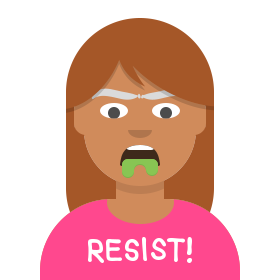

Cut it out, Tom. I'm knee-deep in coolant and about to blow a fuse.
Meanings
A change of clothes.
"Pack a change of clothes."
Collocations & Compounds
climate change
Long-term shifts in temperatures and weather patterns.
We must address climate change urgently.
change management
The process of guiding organizational or system changes.
Effective change management is crucial for success.
change of pace
A break from a usual routine.
A vacation offers a welcome change of pace.
change of heart
A reversal of feelings or intentions.
He had a change of heart about the proposal.
change request
A formal proposal to modify a system or document.
Submit a change request for the software update.
Phrasal Verbs
change around
To rearrange items or people.
Let's change the furniture around in the living room.
change over
To switch from one system, method, or thing to another.
We will change over to the new software next week.
change back
To return something to its previous state or condition.
Can I change back to my original order?
Idioms & Sayings
change one's tune
To alter one's attitude or opinion.
He was against it, but he's changed his tune now.
for a change
To do something different from the usual.
Let's go out to eat, for a change.
make a change
To initiate an alteration or transformation.
She decided to make a change in her career.
the winds of change
Forces that bring about change.
You can feel the winds of change blowing through the company.
change gears
To shift focus or approach.
We need to change gears and start planning the next phase.
Etymology
The word 'change' entered Middle English from Old French 'changier', which itself derived from the Latin 'cambiare', meaning 'to barter or exchange'. This Latin root is thought to have come from a Proto-Indo-European root kemh2-, possibly related to 'to conquer' or 'to grasp'. The earliest recorded uses of 'change' in English date back to the 12th century, initially referring to the act of exchanging goods or money. Over time, its meaning broadened to encompass any kind of alteration or transformation, both physical and abstract. The concept of change is fundamental to human experience, and the word reflects this through its evolution from a concrete act of exchange to a more general notion of becoming different.