size
/saɪz/
The word primarily describes physical scale and spatial occupancy. Unlike "dimension," which often implies a technical or mathematical measurement, "size" is more general and intuitive, focusing on whether something is big or small relative to its surroundings. In the context of clothing and footwear, it shifts from a continuous measure of space to a discrete category (e.g., Small, Medium, Large). This usage transforms the word into a label for standardization rather than a description of unique physical extent. When used as a verb, there is a distinct split between the mundane act of measuring and the specialized technical process in art. In an artistic context, "sizing" refers to creating a protective barrier on a surface, which carries a connotation of preparation and preservation that is absent from the general meaning.
Uncountable when discussing the general concept of physical dimensions ('the size of the room'). Countable when referring to a specific standard used for clothing or footwear ('a size ten' or 'various sizes of boots').
💬Casual Conversation
I'm totally bombing this thrift haul. This dress is like a toddler size.
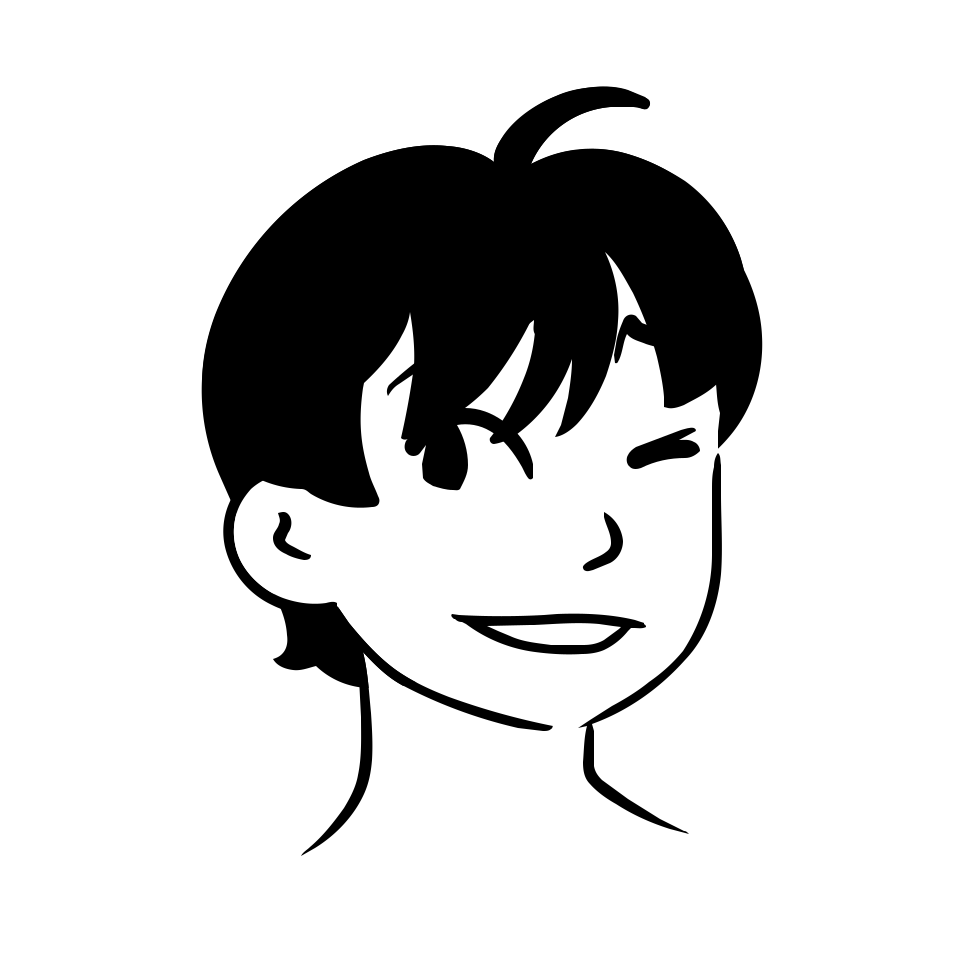

Maybe stop blowing your budget on randoms and focus on the midterm.
Meanings
The relative extent of something; a thing's overall dimensions.
"The size of the room was too small for a grand piano."
A standard measure of a garment or shoe, based on the body part it is intended to fit.
"Do you have these boots in a size ten?"
Examples
The sheer size of the mountain range is breathtaking.
I need to find a dress in a smaller size.
The nurse will size the patient for a custom brace.
You must size the wood before applying the final varnish.
Collocations & Compounds
average size
The typical or mean dimensions of a group of objects.
sample size
The number of observations or individuals included in a statistical sample.
shoe size
The standard numerical measurement used to determine the fit of footwear.
full size
Of the standard or maximum dimensions rather than a reduced version.
size up
To assess or evaluate someone or something by looking at them carefully.
Phrasal Verbs
size up
To assess or evaluate a person or situation by observing them carefully.
Idioms & Sayings
size up
To examine someone or something in order to form a judgment or opinion.
one size fits all
Designed to fit any person or suitable for all purposes regardless of individual differences.
Cultural Context
When we think of a painting, we usually focus on the brushstrokes and the colors, but the secret to a masterpiece often lies in a hidden step called sizing. In the world of fine art, to size a canvas means to apply a gelatinous substance, traditionally made from animal hide glue, to the raw fabric. Without this critical preparation, the oil paint would soak directly into the fibers of the linen or cotton, causing the fabric to rot over time due to the acidic nature of the oil.<br><br>This process creates a protective barrier that prevents the paint from bleeding into the weave, ensuring that the pigment sits on the surface and retains its vibrancy. Historically, sizing was a laborious craft; artists had to carefully heat the glue and apply it in thin, even layers. If the sizing was too thick, the canvas would become brittle and crack; if it was too thin, the painting would eventually degrade. This technical necessity highlights the intersection of chemistry and art, where the physical size of the canvas is less important than the chemical size applied to its surface.<br><br>Modern artists often use acrylic gesso, which combines sizing and priming into one step, but traditionalists still swear by rabbit-skin glue for its superior tension and archival qualities. The act of sizing is essentially an act of preservation, ensuring that the artist's vision survives for centuries by managing the interaction between the organic fabric and the chemical paint. It is a reminder that every great work of art is built upon a foundation of invisible, technical precision.