wide
/wɑed/
Describes an expansive lateral distance or a broad spectrum of variety. It suggests openness and lack of restriction. When applied to physical space, it contrasts with 'narrow'. While 'broad' often implies a certain grandeur or strength (like 'broad shoulders'), 'wide' is more neutral and descriptive of sheer measurement. In an abstract sense, it denotes inclusivity and diversity. A "wide range" suggests a comprehensive collection that spans across different categories rather than deep specialization in one. As an adverb, it conveys a sense of maximum capacity or suddenness, often linked to emotional reactions like shock or amazement (e.g., eyes wide open).
💬Casual Conversation
Did you leave the garage door wide open all night?

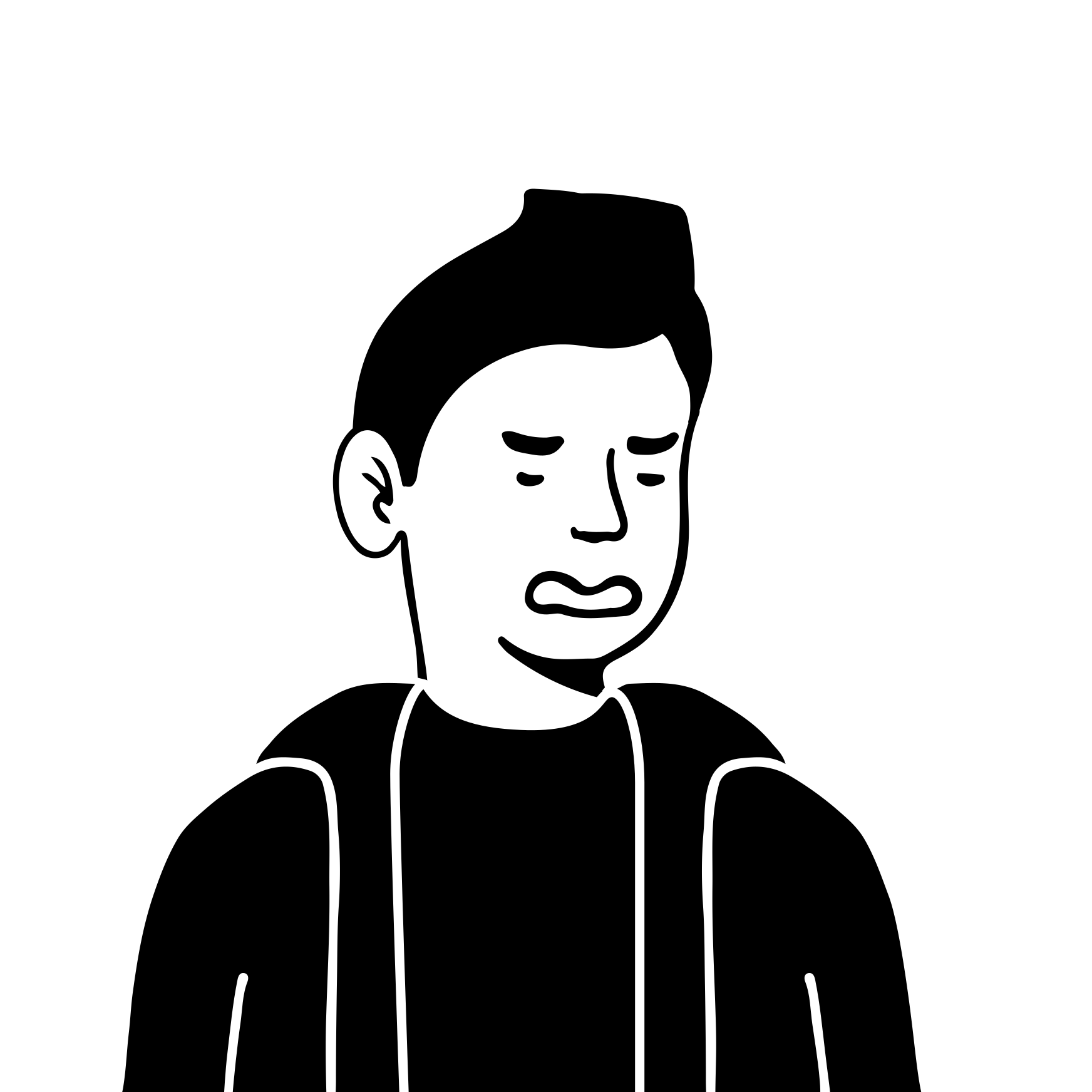
Just optimizing our energy footprint with passive cooling, babe.
Meanings
Examples
The road is too wide for the small car to block.
The museum exhibits a wide variety of ancient artifacts.
She stared at the map with her eyes open wide.
Collocations & Compounds
wide open
completely open, with no obstruction.
The door was wide open.
wide range
a large variety of things.
We offer a wide range of products.
wide awake
fully awake and alert.
He was wide awake despite the late hour.
wide world
the entire planet and all the people on it.
She wanted to see the wide world.
wide screen
a screen that is wider than it is tall, typically used for films.
The movie was filmed in wide screen.
Phrasal Verbs
wide open
completely open or unobstructed
The front door was left wide open during the party.
Idioms & Sayings
wide awake
completely awake and alert
After drinking a double espresso, he was wide awake at three in the morning.
wide of the mark
incorrect or inaccurate
The initial estimate for the project cost was wide of the mark.
far and wide
over a large area or distance
People traveled from far and wide to witness the solar eclipse.
wide open
completely accessible or undecided
The race for the championship is still wide open.
Cultural Context
The Wide World of the Great Barrier Reef: A Biological Metropolis
The Great Barrier Reef is the ultimate manifestation of a wide biological expanse, stretching over 2,300 kilometers along the coast of Australia. It is not a single continuous wall of coral, but a vast network of nearly 3,000 individual reefs and 900 islands. This wide distribution of ecosystems creates a critical sanctuary for thousands of species, ranging from microscopic plankton to the massive whale shark.<br><br>What makes this wide array of life so fascinating is the symbiotic relationship between the coral polyps and zooxanthellae. These tiny algae live within the coral tissues, providing energy through photosynthesis while receiving protection in return. This partnership allows the reef to build massive calcium carbonate structures that can be seen from outer space, illustrating how a wide scale of geological formation begins with a microscopic interaction.<br><br>However, the wide reach of the reef also makes it vulnerable to global climate shifts. Ocean acidification and rising temperatures lead to coral bleaching, where the symbiotic algae are expelled. Because the reef is so wide and interconnected, a localized disaster can have cascading effects across the entire system. Protecting this wide ecological treasure is not just about saving a few species, but about preserving a complex, living architecture that regulates ocean health on a global scale.
Etymology
The word 'wide' comes from the Old English word 'wīd', which itself derives from the Proto-Germanic 'wīdaz'. It has consistently meant 'broad', 'spacious', or 'extended in space' throughout its history in English, with related words appearing in other Germanic languages like German ('weit') and Dutch ('wijd'). Its usage has expanded metaphorically over time to include abstract concepts like 'wide range' or 'wide appeal'.