court
The word evokes a sense of structured space—whether that is the rigid formality of law, the strict boundaries of athletics, or the hierarchical etiquette of royalty. In its legal sense, it carries a weight of authority and finality. It is not merely a room, but an institution of power where judgment is rendered. When used as a verb for romance, it suggests a traditional, deliberate process of winning someone over. This differs from 'dating' by implying a more focused, intentional pursuit of a long-term commitment. In the context of danger (e.g., "courting disaster"), it takes on a provocative tone. It describes a reckless invitation of misfortune, suggesting that the person is effectively flirting with a negative outcome.
Typically refers to a discrete entity, whether it is a legal institution ('the Supreme Court'), a sports area ('a basketball court'), or a royal entourage ('the court of Louis XIV').
💬Casual Conversation
Yo, still gonna hit the court later?
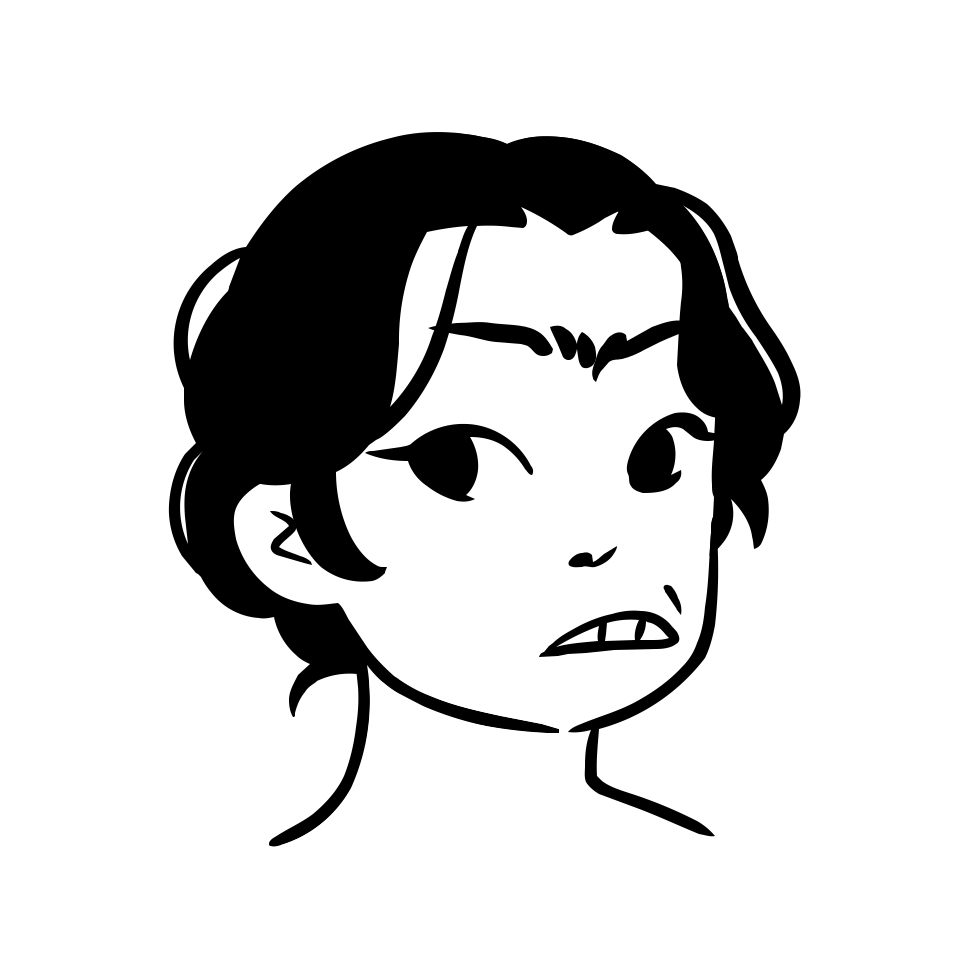

Nah, man. Gotta grind this ranked match.
Meanings
A tribunal presided over by a judge, in which disputes are settled by legal proceedings.
"The case was brought before the high court."
A rectangular area marked out for playing a game such as tennis or basketball.
"They spent the entire afternoon on the tennis court."
The residence, household, and surroundings of a sovereign.
"The ambassadors were summoned to the royal court."
To seek the favor, love, or attention of someone, often with the intent of marriage.
"He spent months courting her before proposing."
To behave in a way that is likely to attract or invite something unpleasant.
"Ignoring safety regulations is simply courting disaster."
Collocations & Compounds
royal court
The king, queen, or other ruler and their family, advisors, and household.
The royal court was known for its lavish spending.
court order
An official command or directive issued by a judge or court of law.
The police acted on a court order to seize the property.
court appearance
The act of attending a court of law as a defendant, witness, or other party.
He has a court appearance scheduled for next Tuesday.
court records
Official documents and transcripts related to legal proceedings.
Researchers accessed the court records to study the case.
court jester
A professional joker or "fool" attached to a royal or noble household.
The court jester entertained the king with witty remarks.
Phrasal Verbs
court out
To eliminate or defeat someone or something.
The underdog team was unexpectedly courted out in the first round.
Idioms & Sayings
court disaster
To behave in a way that is likely to lead to serious trouble or failure.
By ignoring the safety regulations, they were courting disaster.
court death
To behave in a way that is very likely to result in one's death.
Walking across the thin ice was like courting death.
court favor
To try to gain the approval or support of someone, typically someone in a position of power.
He spent years trying to court favor with the CEO.
court attention
To behave in a way that deliberately attracts notice or scrutiny.
Her flamboyant style seemed designed to court attention.
Etymology
The word 'court' originates from the Old French 'cort' or 'court', meaning 'enclosed space', 'courtyard', 'palace', or 'retinue'. This, in turn, comes from the Latin 'cohors', which originally meant 'a troop of soldiers' or 'an enclosed space' and later evolved to mean 'a courtyard' or 'a palace'. In English, it initially referred to the courtyard of a castle or manor house, and by extension, the people residing there, especially the sovereign and their household. This sense broadened to include the place where justice is administered and the body of judges.