Note: The translation for this entry is currently under quality review. Some content is temporarily displayed in English only.
full
The primary image is one of saturation and capacity. It describes a state where no more space, time, or substance can be added without overflow or completion. When applied to physical containers, it is neutral. When applied to information (e.g., a "full report"), it conveys thoroughness and rigor, suggesting that nothing has been omitted. In the context of eating, it describes a physical sensation of satiety. This is often used as a polite boundary or a signal of satisfaction. As an adverb, it carries a sense of absolute intensity or totality, though in modern standard English, "fully" is more common for this purpose.
💬Casual Conversation
I'm absolutely stuffed. This synthetic stew is just too much.
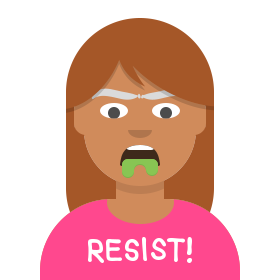

Cut the drama. The nutrient bin is full, so eat up or starve.
Meanings
Containing or holding as much or as many as possible; allowing no more to be added.
"The glass is full of water."
Having eaten enough food to be satisfied.
"I cannot eat another bite; I am completely full."
To make something full or to fill a fabric by pressing it.
"The miller worked to full the wool cloth."
Completely; fully.
"He was full aware of the consequences."